When an Early Report Says ‘Unconfirmed’
Learn how to read an early report marked unconfirmed by separating established details, attributed claims and open questions without guessing what comes next.
The most common mistake with an early report marked “unconfirmed” is to treat the label as a temporary inconvenience and read the rest as settled fact. That can turn a reported claim into a remembered certainty, especially when a vivid detail spreads faster than the careful wording around it. A better approach is to sort what the report actually says before deciding what it means.
Uncertainty is not one blank space. An account may establish that an event occurred while leaving its cause unclear; it may quote an official claim that has not been independently checked; or it may simply lack information about what happened next. Read the pieces separately, and you can follow a developing story without filling its gaps with a prediction.
What does “unconfirmed” apply to?
Start by locating the word and identifying its subject. Does the report call the whole account unconfirmed, or does it say that one detail—such as the number of people involved, the cause of an incident, or the identity of a person—remains unconfirmed? Those are different claims about the limits of the reporting.
Read the sentence before and after the label, then scan the opening for wording such as “according to,” “officials said,” “witnesses reported,” or “the outlet could not verify.” These phrases identify who is making a claim and what the newsroom says it has been able to establish. They should not be collapsed into one general impression that “the report says it happened.”
Also notice whether the label appears in a headline, a caption, a live-update entry, or the body text. A short update may preserve uncertainty more visibly than a headline, which has little room for qualification. If the article changes over time, note whether a later update clarifies the original wording rather than assuming the first version still describes the current state of knowledge.
Write down the specific thing the report marks as unconfirmed. A narrow question is easier to assess than a vague sense that the whole story is uncertain.
Which details are confirmed, attributed, or still open?
Make three mental piles—or use a brief note if several updates are arriving at once. The labels are not grades of truth; they describe how each detail is presented and what kind of support the report gives it.
- Confirmed in the account: Details the report presents as established, with the basis made clear enough to follow. For example, it may state that a public agency issued a notice, or that a road is closed, and identify the agency or notice behind that information.
- Attributed claim: Information assigned to a named source or group, such as a police spokesperson, a local resident, an organization, or an unnamed official. Preserve the attribution when you repeat it: “the agency said” is not the same as “it happened.”
- Open question: A point the report says is unknown, unverified, disputed, or not yet explained. Keep it open rather than promoting a plausible answer into a fact.
The first pile still deserves attention to wording. “Confirmed in the account” does not mean every outlet, agency, or observer independently verified the detail. It means the report presents it as established, and a careful reader can inspect the stated basis instead of extending that certainty to other parts of the story.
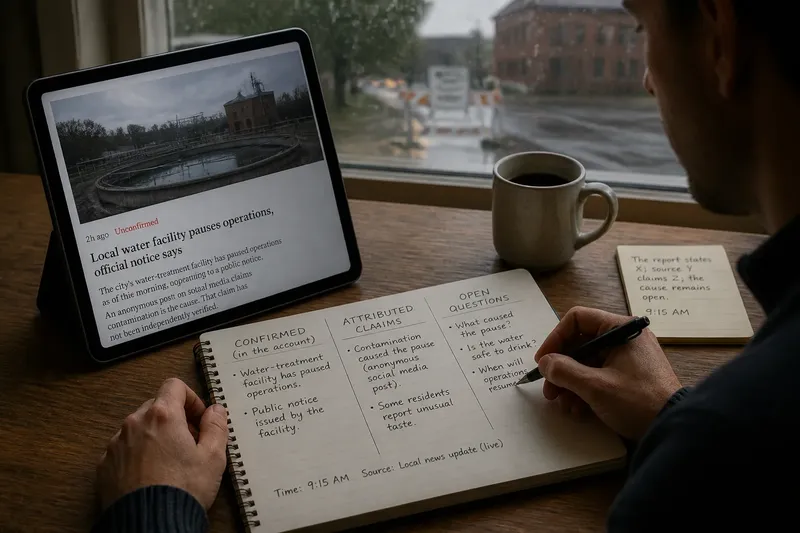
Imagine an early local report says a water-treatment facility has paused operations, quoting the facility’s public notice, while an unnamed post claims contamination caused the pause. The notice supports the pause as reported; the post remains an attributed claim of uncertain standing; the cause is an open question unless the account supplies stronger confirmation. The observable result of sorting the details is a more precise retelling: operations are reported paused, while the reason has not been established.
Keep the source attached to the claim when you make a note or tell someone else. Attribution is part of the information, not a disposable preface.
Who is making each claim, and what can they know?
Identify the speaker before weighing the detail. An agency may be positioned to describe its own actions; a witness may be able to describe what they saw from a particular place; a spokesperson may communicate an organization’s current account. None automatically answers every question about cause, sequence, responsibility, or broader impact.
Look for the difference between direct observation and interpretation. “I heard a loud sound from the street” describes an experience. “The sound came from a specific device” may be an inference unless the person explains how they know. Reporting can include both, but a reader should keep the observation and the explanation in separate places.
Notice whether the report identifies the source in a way that helps you judge the claim. “A resident near the site” gives some context; “a source familiar with the matter” gives less about position or access. An unnamed source is not automatically unreliable, but the article should offer enough explanation for why the source’s account is relevant and why anonymity was used.
Compare claims without treating repetition as independent confirmation. If several reports all cite the same agency statement, they may be multiple publications of one account, not several separate sources. Look for whether a report describes its own reporting, cites a distinct document or observer, or simply repeats another outlet’s wording.
Ask what the source can support, not whether the source sounds confident. A confident statement about one part of an event does not settle a separate question the source may not have observed.
How can you follow changes without guessing?
When a story is developing, keep track of changes in the claims rather than trying to predict the final account. A short note can preserve the distinction: “The report states X; source Y claims Z; the cause remains open.” Add the update time or version when it is visible, so a later revision does not blur what was said earlier.
On a live page, read the newest entry and the original report together. The latest post may add a correction, narrow an earlier claim, or confirm a detail without resolving the larger question. If an outlet labels an item corrected or updated, check what changed; a correction to one element does not necessarily invalidate every other detail.
When you compare coverage, line up the claims rather than the dramatic wording. Ask whether each outlet attributes the same information to the same source, adds a distinct source, or describes a different level of certainty. If one account says “officials are investigating” and another says “officials confirmed,” inspect the underlying language before treating the difference as a substantive contradiction.
Resist filling a missing explanation with the most familiar storyline. An event may resemble something that happened elsewhere, but resemblance does not establish cause, intent, or outcome in this case. Use what is known to define the question still open, not to answer it by analogy.
For a developing account, a useful update is often modest: “The reported closure is confirmed in the agency notice; the reason remains unclear.” That wording gives the reader something concrete while leaving the unresolved point unresolved.
What should you check before sharing an early report?
Before forwarding a link or repeating a claim, pause long enough to inspect its boundaries. A concise check can prevent an attributed allegation from losing its source, or an unresolved detail from becoming the headline people remember.
- Find the exact uncertainty: Identify which detail the report calls unconfirmed, disputed, or unknown. Do not apply that label to the entire account unless the article does.
- Preserve attribution: Keep “the department said,” “a witness described,” or the article’s equivalent attached to the claim. Do not turn a source’s statement into an unattributed fact.
- Separate observation from explanation: Notice whether the source describes what they saw or offers a conclusion about why it happened. Treat those as distinct claims.
- Check for independent support: See whether another account adds a separate source or document, rather than repeating the same statement through a new outlet.
- Read the latest version: Look for a timestamp, correction, or update that changes the status of a detail. Do not rely on a clipped headline or an old post when the story has moved on.
- Keep unanswered questions open: Avoid adding a cause, identity, sequence, or prediction the reporting has not established.
Imagine you are about to share a post claiming a bridge closure was caused by damage. The linked report confirms that the transportation agency closed the bridge, but says inspectors have not identified the reason. Sharing “The bridge is closed; the cause is still under review” preserves the reported fact and its limit, while the stronger claim would go beyond the account.
If the source link is missing, the wording strips away attribution, or the report has been superseded, hold off on repeating the uncertain detail. You can still share the article with a clear note about what it does and does not establish.
What questions help when a report is still developing?
Does “unconfirmed” mean the report is false?
No. It means the account has not established a particular detail to the level its wording requires, or that the detail remains unresolved. Keep the question open instead of treating the label as proof for either side.
Can several outlets confirm the same claim?
They can, but check whether they rely on separate reporting or the same original statement. Several articles repeating one source’s claim do not, by themselves, show that several independent sources established it.
What if officials disagree with witnesses?
Record who said what and whether each account describes direct observation, official information, or an interpretation. A disagreement may remain unresolved in the report; do not settle it by choosing the more confident-sounding voice.
Should I wait for a later update before sharing anything?
Not necessarily: you can share what the account clearly establishes if you preserve its attribution and state what remains unknown. If the distinction is missing from the post you plan to share, wait or add a precise note of your own.
How do you talk about uncertainty without sounding vague?
Use specific language. “The report says the site is closed” identifies the claim and its source; “something may have happened” obscures both. Likewise, “the cause has not been established in the account” is more informative than “nobody knows,” which may overstate what the reporting can support.
Choose verbs that match the account: “said,” “reported,” “described,” “confirmed,” or “has not determined.” Avoid upgrading “may,” “appears,” or “according to” into a flat statement. Small wording choices can preserve the distance between a source’s account and what the article establishes.
When a detail changes, update your own description rather than defending the first version. The earlier claim may have been reasonable to report with a qualification; later information can narrow or replace it. Accuracy is not a wager on which early account will prove right. It is the habit of describing what the reporting supports at the moment you speak.
For any early report marked unconfirmed, keep the claim, its source, and the unanswered question in view together. That simple discipline lets you follow the news closely without turning uncertainty into a forecast.